
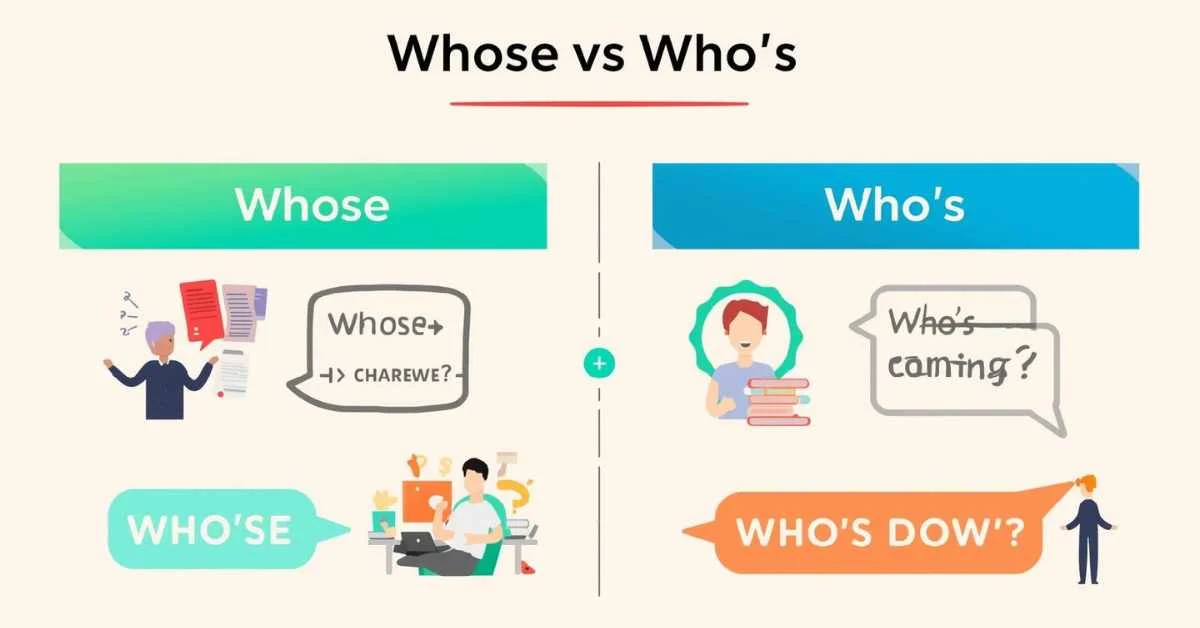
Have you ever typed something like “who’s jacket is this” and felt unsure if it was right? Don’t worry you are not alone. Many people confuse whose or who’s because they sound exactly the same.
Using the wrong one can make your writing look careless, it’s in emails, texts, social media posts, or school essays.
The good news is that the difference is simple. Whose shows ownership, meaning it asks “to whom does this belong?” On the other hand, who’s is a contraction for who is or who has.
This guide will show you the difference, help you avoid mistakes, and use both words correctly every day.
By the end, you’ll never mix them up, and your writing will feel professional and polished.
Whose or Who’s – Quick Answer
- Whose → Shows ownership.
Example: Whose shoes are these? - Who’s → Contraction of who is or who has.
Example: Who’s ready for dinner?
Tip: If you can replace the word with who is or who has, use who’s. If that doesn’t make sense, it’s whose.
Mini-test:
- ___ coming to the party? → Who’s
- ___ notebook is this? → Whose
The Origin of Whose or Who’s
- Whose comes from Old English hwæs, meaning “of whom” or “belonging to whom.” It has always shown ownership.
- Who’s is a modern contraction of who is or who has, first appearing in the 1600s.
- Both forms have survived in modern English, but their use depends on meaning, not pronunciation.
Fun Fact: Even famous writers like Shakespeare used who’s. This shows it has been used for a long time in casual writing.
British English vs American English
Both British and American English follow the same rules for whose and who’s, but usage style differs slightly.
| Form | British English | American English | Example |
|---|---|---|---|
| Whose | Same | Same | Whose bag is this? |
| Who’s | Same | Same | Who’s finished their homework? |
Tip: The difference isn’t spelling it’s tone. Formal writing prefers clarity, while casual writing allows contractions.
Which Spelling Should You Use?
- Formal writing: Use whose for possession; avoid who’s unless casual tone is acceptable.
- Informal writing: Who’s is fine for social media, chats, and blogs.
- Global English: Stick to the rule: whose = possession, who’s = contraction.
Common Mistakes with Whose or Who’s
- Incorrect: Whose coming to the meeting?
Correct: Who’s coming to the meeting? - Incorrect: Who’s coat is this?
Correct: Whose coat is this? - Incorrect: I don’t know who’s bag is on the table.
Correct: I don’t know whose bag is on the table. - Incorrect: Whose done their homework?
Correct: Who’s done their homework?
Pro Tip: Replace the word with who is or who has. If it works, it’s who’s. If not, it’s whose.
Whose or Who’s in Everyday Examples
- Emails: Who’s available for a quick meeting today?
- Social media: Whose idea was this amazing meme?
- News articles: Who’s responsible for the new policy?
- School essays: Whose research inspired this study?
- Texts: Who’s ready for dinner?
- Signs or notices: Whose bag is left in the classroom?
Tip: Using the right form makes your writing professional and avoids confusion.
Whose or Who’s – Google Trends & Usage Data
- Popularity: Searches for “whose or who’s” peak during school and exam seasons.
- Top countries searching: United States, United Kingdom, Canada, Australia.
- User intent: Most people search to clarify usage and avoid mistakes in writing.
SEO Insight: Keywords like “whose vs who’s,” “difference between whose and who’s,” “grammar rules whose or who’s” are highly searched.
Comparison Table – Whose vs Who’s
| Feature | Whose | Who’s |
|---|---|---|
| Type | Possessive pronoun | Contraction of who is / who has |
| Usage | Shows ownership | Shortens two words |
| Example | Whose phone is ringing? | Who’s finished their homework? |
| Quick Tip | Replace with “of whom” if confused | Replace with “who is” or “who has” |
FAQs
1. Can “who’s” ever show possession?
No, only whose shows possession.
2. Can “whose” refer to objects?
Yes, e.g., Whose phone is this?
3. Can I use “who’s” in formal writing?
Yes, but sparingly. Prefer full words (who is / who has) in professional documents.
4. How can I check which one to use quickly?
Replace with who is or who has. Works? → who’s. Doesn’t work? → whose.
5. Can “whose” start a sentence?
Yes. Example: Whose turn is it to speak?
6. Are there pronunciation differences?
No, they sound the same; context is key.
7. Why do people confuse them so much?
Because they are homophones same sound, different meaning.
Conclusion
Using whose or who’s correctly is easy once you remember the rules. Whose always shows possession, while who’s is a contraction of who is or who has. Test your choice by replacing who’s with who is, if it works, it’s correct; if not, it’s whose.
From emails and essays to social media posts, choosing the right form improves clarity and professionalism. Bookmark this guide and practice a few examples each day. With consistent use, whose or who’s will become second nature in your writing, and you’ll never mix them up again.

Hi, I’m Lydia Fenn, and I love making English grammar simple and fun. On Punspanda.com, I share tips, examples, and tricks to help you write confidently and never get tripped up by tricky rules.