A height and weight chart is a simple tool that helps you understand whether your body weight falls within a healthy range for your height, age, and gender.
Many people use these charts to track fitness progress, monitor growth, or get a general idea of where they stand health-wise. While no chart can define perfect health, height and weight charts provide a useful starting point for setting realistic and informed health goals.
These charts are commonly used by doctors, fitness professionals, and parents because they offer quick reference ranges rather than exact numbers.
They also work alongside tools like BMI to give a broader picture of body health. It’s important to remember that factors such as muscle mass, body composition, age, and genetics all influence what a healthy weight looks like for each individual.
In this guide, you’ll find easy-to-read height and weight charts for men, women, children, and different age groups, along with practical tips on how to use them correctly and responsibly.
What Is a Height and Weight Chart?
A height and weight chart is a reference table that shows a healthy or average weight range for different heights. These charts are designed to help individuals quickly assess whether their body weight is generally considered underweight, healthy, or overweiight based on standardized health data. Rather than giving a single “ideal” number, most charts present weight ranges, which is more realistic and medically appropriate.
Height and weight charts are widely used in healthcare, fitness, and education settings. Doctors may use them during routine checkups, parents use them to monitor children’s growth, and adults often rely on them to set fitness or wellness goals. Unlike appearance-based standards, these charts are grounded in population-level health research and often align with tools such as BMI (Body Mass Index).
It’s important to understand that a height and weight chart does not diagnose health conditions. Instead, it offers a general guideline that works best when combined with other factors like age, gender, body composition, and activity level. Charts may vary slightly depending on the source, country, or measurement system used (metric or imperial). The goal is consistency and understanding trends over time rather than obsessing over exact numbers.
How to Read a Height and Weight Chart Correctly
Understanding how to read a height and weight chart correctly is essential to avoid confusion or unrealistic expectations. These charts are meant to provide healthy weight ranges, not exact targets, so interpretation matters just as much as the numbers themselves.
- Locate Your Height: Heights are usually listed in centimeters and feet/inches. Once you find your height, move across the row or column to see the corresponding weight range.
- Check the Measurement Unit: Ensure your weight and height are in the same units as the chart. Mixing kilograms with pounds or feet with centimeters can lead to mistakes.
- Focus on the Range: Being slightly above or below the range does not automatically indicate poor health. Muscle mass, body frame, and activity level influence where your weight may naturally fall.
- Use the Right Chart: Men, women, children, and older adults all have different charts. Using a chart designed for your specific group is key for accuracy.
When used as a reference rather than a rule, height and weight charts can be a helpful guide for tracking health trends over time.
Height and Weight Chart for Adult Men
A height and weight chart for adult men provides a general guideline for understanding what a healthy weight range may look like based on height. Adult men typically have a higher percentage of muscle mass and denser bone structure compared to women, which is why their weight ranges are generally higher for the same height.
| Height (ft/in) | Height (cm) | Healthy Weight Range (lbs) | Healthy Weight Range (kg) |
|---|---|---|---|
| 5’4” | 163 | 125 – 145 | 57 – 66 |
| 5’6” | 168 | 132 – 155 | 60 – 70 |
| 5’8” | 173 | 140 – 165 | 63 – 75 |
| 5’10” | 178 | 150 – 175 | 68 – 79 |
| 6’0” | 183 | 160 – 185 | 73 – 84 |
Muscle mass, age, and lifestyle affect where an individual falls within the range. Men who are highly active or muscular may weigh more while still being perfectly healthy.
Height and Weight Chart for Adult Women
A height and weight chart for adult women helps estimate a healthy weight range based on height while accounting for natural differences in female body composition. Women generally carry a higher percentage of body fat and lower muscle mass, so weight ranges differ from men’s charts.
| Height (ft/in) | Height (cm) | Healthy Weight Range (lbs) | Healthy Weight Range (kg) |
|---|---|---|---|
| 5’0” | 152 | 95 – 115 | 43 – 52 |
| 5’2” | 157 | 105 – 125 | 48 – 57 |
| 5’4” | 163 | 110 – 135 | 50 – 61 |
| 5’6” | 168 | 115 – 145 | 52 – 66 |
| 5’8” | 173 | 125 – 155 | 57 – 70 |
Age, hormonal changes, and body frame influence healthy weight. Charts provide ranges rather than exact numbers, and slight deviations are normal.
Height and Weight Chart by Age (Children & Teenagers)
A height and weight chart by age is essential for tracking growth in children and teenagers. These charts use percentiles to show how a child compares to peers. Consistency in growth along a percentile is more important than hitting exact numbers.
Children (2–12 years): Growth varies due to genetics, nutrition, and activity. Falling consistently within a percentile indicates healthy development.
Teenagers (13–19 years): Growth spurts and puberty cause rapid changes. Gender-specific charts are important, develop differently during adolescence.
Age-based charts are monitoring tools and should be used alongside indicators like energy levels, appetite, and overall well-being.
Height and Weight Chart for Older Adults (50+)
For adults over 50, metabolism slows, muscle mass decreases, and bone density changes. Height and weight charts for older adults provide guidelines for healthy weight, emphasizing function over exact numbers.
Slightly higher weights may be healthier than being underweight, as too low a weight increases risk of weakness and falls. Regular physical activity, resistance training, and proper nutrition help maintain muscle mass and overall health.
Metric vs Imperial Height and Weight Charts
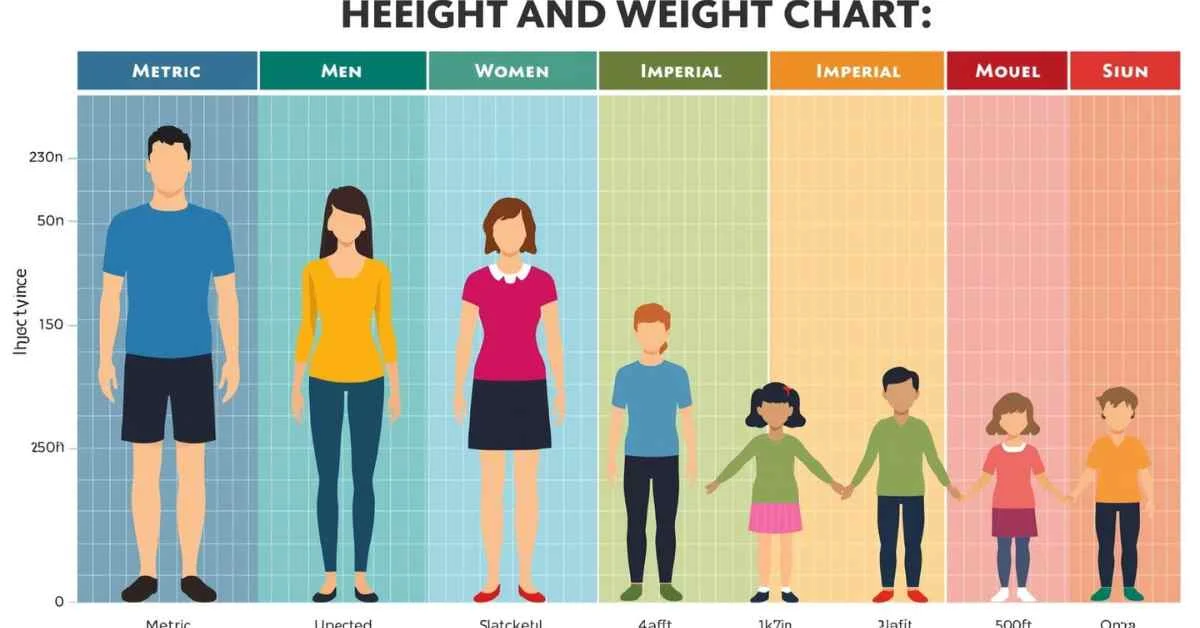
Height and weight charts are available in metric (kg/cm) and imperial (lbs/ft-in) units. Metric charts are widely used worldwide, while imperial charts are common in the U.S. Many charts include both units for convenience.
Correctly matching your measurements to the chart’s units ensures accuracy. Charts provide ranges, not fixed numbers, and the principles remain the same regardless of units.
Ideal Weight vs Healthy Weight – What’s the Difference?
Ideal weight often refers to a single number considered “perfect,” influenced by aesthetics. Healthy weight is a range based on health outcomes, supporting cardiovascular, metabolic, and musculoskeletal health. Muscle mass, body frame, age, and activity all influence healthy weight. Height and weight charts focus on healthy ranges, not a single “ideal” number.
Height and Weight Chart Explained BMI
(Body Mass Index) charts calculate weight relative to height:
Body Mass Index = weight (kg) ÷ [height (m)]²
BMI = 703 × weight (lbs) ÷ [height (in)]²
Body Mass Index categories:
- Underweight: <18.5
- Normal weight: 18.5–24.9
- Overweiight: 25–29.9
- Obesity: ≥30
BMII charts complement height and weight charts but do not account for muscle vs fat, so they should be used alongside other indicators.
Height and Weight vs BMI Chart – Which Is Better?
Height and weight charts are simple visual guides, while BMI charts provide a numerical standard for health assessment. Both have limitations: BMI ignores muscle mass, height-weight charts ignore body composition. Using both together, along with waist measurements, activity levels, and overall fitness, gives the most accurate health picture.
Factors That Affect Healthy Weight
- Age: Slower metabolism with age
- Gender: For Both differ in body composition
- Muscle Mass: Higher muscle affects weight
- Body Frame Size: Bone structure influences healthy range
- Genetics: Family history impacts weight
- Activity Level: Sedentary vs active lifestyle
- Medical Conditions & Medications: Affect weight
Charts are guidelines and should be interpreted considering these factors.
Are Height and Weight Charts Accurate?
Charts are general guidelines, not diagnostic tools. They don’t account for muscle mass, fat distribution, or population diversity. Charts work best when used alongside BMI, waist circumference, activity level, and regular medical assessments.
When You Should See a Doctor
Consult a doctor if you notice:
- Rapid or unexplained weight changes
- Children falling consistently outside growth percentiles
- Extreme BMI or weight measurements
- Persistent fatigue, weakness, or other health symptoms
Charts guide trends, but professional evaluation ensures safe and accurate health monitoring.
Printable Height and Weight Chart (Free Download)
Printable charts provide a visual reference to track growth or fitness trends. Many include metric and imperial units and highlight healthy ranges. Use them at home, in gyms, or in clinics to monitor children or adults. Accuracy improves when measurements are recorded regularly and combined with other health indicators.
Frequently Asked Questions (FAQ)
Q1. What is the normal weight for my height?
Depends on height, age, gender, and body composition. Charts show ranges.
Q2. How much should I weigh for my age?
Weight varies naturally with age. Age-based charts provide general guidelines.
Q3. Is BMI accurate for athletes?
BMI may overestimate weight risk in muscular individuals. Charts must be interpreted with context.
Q4. Can height and weight charts predict health?
No. Charts are guidelines. They should be used with other health indicators.
Q5. Should I trust online charts?
Use charts from reliable sources. Consult a doctor if your weight falls outside normal ranges or changes rapidly.
Final Thoughts – How to Use Height and Weight Charts Wisely
Height and weight charts are guidelines for informed health decisions, not strict rules. Focus on ranges, trends over time, and your unique body composition. Avoid comparing yourself to others, and combine chart use with healthy habits like balanced nutrition, exercise, sleep, and regular medical checkups.
Used thoughtfully, height and weight charts help track growth, set achievable goals, and maintain long-term health for adults, children, and older adults alike.

Hi, I’m Jam Sun, the creator of Punspanda.com. I write fun, clever puns, jokes, and easy-to-read humor content designed to entertain, inform, and make people smile. My goal is simple: turn everyday words into share-worthy laughs.