
Height has always been one of the most discussed and analyzed aspects of basketball. Step into any NBA arena, and you’ll immediately notice that players tower over the average person—but just how tall are NBA players really?
Understanding the average NBA height not only satisfies curiosity but also reveals how the league has evolved over time, how different positions require specific physical attributes, and how height impacts performance. From nimble point guards to towering centers, each role comes with its own expectations and advantages.
Many fans assume that height alone determines success in the NBA. However, history proves otherwise. Legendary players under 6’3”, like Chris Paul and Allen Iverson, have thrived through skill, speed, and basketball IQ, proving that vertical inches are only part of the equation.
In this article, we’ll break down the average NBA height, analyze it by position, explore historical trends, compare it globally, examine its impact on performance, and even highlight some fun facts and quirky stats about the tallest and shortest NBA stars. By the end, you’ll have a complete understanding of height in professional basketball.
The Current Average NBA Height
The current average NBA height is approximately 6’6” (198 cm), making NBA players significantly taller than the average adult male in the United States, who measures about 5’9” (175 cm). This 9-inch difference highlights the physical specialization required at the professional level. Height in basketball isn’t just aesthetic—it directly affects a player’s ability to score, defend, and rebound effectively.
Taller players naturally dominate in rebounding and shot-blocking, while slightly shorter players often excel in speed, agility, and perimeter play. This combination allows for diverse strategies and a variety of player profiles to thrive in the league.
Here’s a comparison for context:
| Category | Average Height |
|---|---|
| NBA Player | 6’6” (198 cm) |
| US Male Adult | 5’9” (175 cm) |
| NBA Center | 6’11”–7’0” (210–213 cm) |
| NBA Point Guard | 6’1”–6’3” (185–190 cm) |
While height offers advantages, it’s not everything. Players like Chris Paul (6’1”) and Allen Iverson (6’0”) have proven that intelligence, skill, and leadership can overcome a height disadvantage, making the game as much about brain as brawn.
Average Height by Position
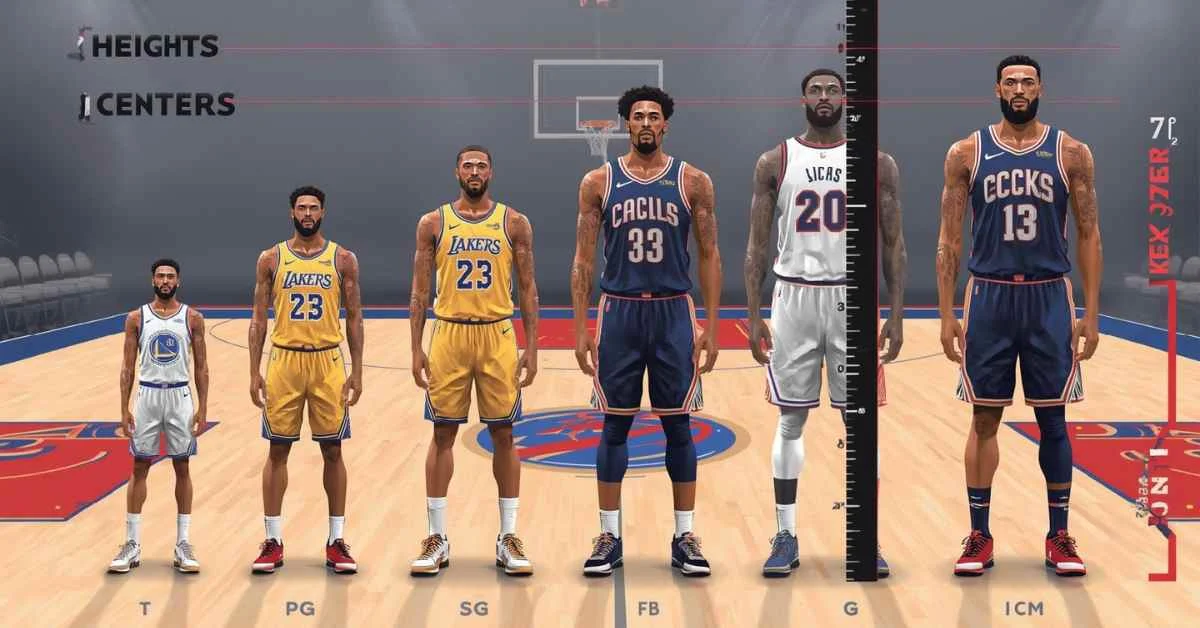
The NBA isn’t uniform in terms of height; it varies by position, reflecting the unique skills and responsibilities of each role. Understanding the average height by position shows how teams balance speed, agility, and reach to optimize performance.
Point Guards (PG): Typically the shortest on the team, point guards control the offense and handle the ball. Their average height is 6’2” (188 cm). Quickness, court vision, and accurate shooting allow these players to lead despite being below the league average in height.
Shooting Guards (SG): These players combine scoring and defensive duties, standing around 6’5” (196 cm). Shooting guards must shoot over defenders while remaining agile on the perimeter.
Small Forwards (SF): Often versatile, small forwards average 6’7” (200 cm), balancing scoring, defense, and rebounding. Their height allows them to guard multiple positions and contribute across the court.
Power Forwards (PF): Playing near the basket, power forwards rely on size and strength, averaging 6’9” (206 cm). They dominate rebounds and provide interior scoring, often challenging taller centers.
Centers (C): The tallest players in the league, centers usually exceed 7 feet (213 cm). They protect the rim, grab rebounds, and control the paint. Stars like Shaquille O’Neal and Yao Ming exemplify the impact of height at this position.
A bar chart comparing average heights across positions clearly demonstrates the progression from point guard to center, showing how physical traits match each role.
Historical Trends in NBA Height
The NBA has evolved dramatically over the decades, and so has the average player height. In the 1950s and 1960s, the league averaged around 6’4” (193 cm), emphasizing fundamentals, shooting, and teamwork over raw size. Dominant big men like Wilt Chamberlain were rare exceptions.
By the 1970s and 1980s, the league shifted. Players became taller, with an average of 6’6” (198 cm), as centers like Kareem Abdul-Jabbar (7’2”) and Moses Malone (6’10”) redefined the game. Rebounding, shot-blocking, and interior dominance became key factors in team strategy.
The 1990s and 2000s brought further height evolution. Power forwards and small forwards grew taller and more versatile, handling the ball, shooting from mid-range, and defending multiple positions. The league embraced athleticism, combining speed with size, creating more dynamic gameplay.
From the 2010s to today, “positionless basketball” emerged. Height remains an advantage, but speed, shooting, and versatility are equally important. The average height has stabilized around 6’6”, but the distribution is more varied, with shorter guards and taller forwards thriving together.
This historical perspective shows that while the NBA has generally gotten taller, modern basketball rewards a combination of height, skill, and versatility.
Height vs Performance in the NBA
Height clearly affects certain areas of performance. Taller players dominate rebounds, shot-blocking, and scoring near the basket, while shorter players shine in speed, agility, and ball-handling.
Centers over 7 feet, like Rudy Gobert or Shaquille O’Neal, leverage height to protect the rim and control the paint. Conversely, point guards under 6’2”, like Chris Paul and Allen Iverson, excel in assists, fast breaks, and scoring despite being shorter than average.
| Player Type | Average Height | Strengths |
|---|---|---|
| Center | 6’11”–7’0” | Rebounds, blocks, inside scoring |
| Power Forward | 6’9” | Inside scoring, defense, rebounds |
| Small Forward | 6’7” | Versatility, perimeter defense, mid-range scoring |
| Shooting Guard | 6’5” | Scoring, perimeter defense |
| Point Guard | 6’2” | Speed, assists, playmaking |
Statistically, height correlates strongly with rebounds and blocks, but less with assists or three-point shooting. This explains why players of all sizes can dominate different areas of the game. Ultimately, skill, strategy, and athleticism often outweigh raw height.
International Comparisons of NBA Height
While the NBA averages 6’6”, international leagues vary slightly. In the EuroLeague, players average 6’5” (196 cm), emphasizing skill, shooting, and tactical play. In Asian leagues, such as Japan’s B.League or China’s CBA, players average 6’2”–6’3” (188–190 cm).
International stars have increasingly impacted NBA height trends. Giannis Antetokounmpo (6’11”) and Luka Dončić (6’7”) combine size, skill, and versatility, bridging height advantages with modern positionless play.
Global competitions, like the FIBA World Cup and Olympics, show that while taller teams dominate rebounds and defense, shorter squads succeed with speed, shooting, and teamwork. Height is an advantage, but strategy and skill often determine outcomes, both internationally and in the NBA.
Tallest and Shortest Players in NBA History
Tallest Players: Gheorghe Mureșan and Manute Bol, both 7’7” (231 cm), are the tallest players ever. Yao Ming, at 7’6”, dominated inside play and became a global icon. Their height provided unmatched reach for rebounds and shot-blocking.
Shortest Players: Muggsy Bogues (5’3”) and Spud Webb (5’7”) show that talent and agility can overcome a height disadvantage. Webb famously won the Slam Dunk Contest, proving that skill and vertical leap can rival height.
Fun fact: While tall players excel in rebounds and blocks, some of the greatest scorers and playmakers have been shorter than average, showing that skill, determination, and basketball IQ are equally important.
Height vs Modern NBA Strategy
Modern NBA strategy blends height with versatility. Positionless basketball allows players to perform multiple roles regardless of height.
Small-ball lineups favor faster, more agile forwards over traditional centers, improving spacing and fast-break opportunities. Stretch bigs, like Kevin Durant (6’10”) and Kristaps Porziņģis (7’0”), combine height with perimeter shooting, forcing defenses to adjust.
Defensively, taller players protect the rim, but agility and intelligence allow teams to handle smaller, faster opponents. The modern NBA rewards versatility, skill, and basketball IQ, proving that height alone does not guarantee success.
Fun Facts and Quirky NBA Height Stats
- Tallest active players: Bol Bol (7’2”), Kristaps Porziņģis (7’0”)
- Shortest active players: Chris Clemons (5’9”), Facundo Campazzo (5’10”)
- Height extremes: Some games feature 2-foot differences between matchups
- Dunking under 6 feet: Spud Webb won the Slam Dunk Contest at 5’7”
- NBA height over decades: 6’4” in the 1950s → 6’6” today
- Positionless players: LeBron James (6’9”) plays almost every position
- Comparison: Average NBA player (6’6”) is 9 inches taller than the average US male
These quirky stats highlight the diversity and excitement of NBA player heights.
NBA Height FAQs
1. What is the average height of an NBA player?
6’6” (198 cm)
2. Who is the tallest NBA player ever?
Gheorghe Mureșan and Manute Bol, 7’7” (231 cm)
3. Who is the shortest NBA player ever?
Muggsy Bogues, 5’3” (160 cm)
4. What is the average height of a point guard?
6’2” (188 cm)
5. Does height guarantee NBA success?
No—skill, strategy, and basketball IQ often outweigh height.
6. How has NBA height changed over time?
From 6’4” in the 1950s to 6’6” today, reflecting league evolution.
Conclusion
Height in the NBA is fascinating but only part of the story. The average NBA player height of 6’6” shows the league’s preference for taller athletes, yet skill, speed, and basketball IQ often determine success. Historical trends show gradual increases in height, but modern strategies like positionless basketball emphasize versatility. International comparisons highlight that while height is advantageous, skill and strategy are equally critical.
From Muggsy Bogues to Shaquille O’Neal, the NBA proves that maximizing strengths, adapting, and combining skill with height is the true formula for success. Whether towering or compact, a player’s impact depends on more than just inches—it’s about talent, determination, and smart play.